
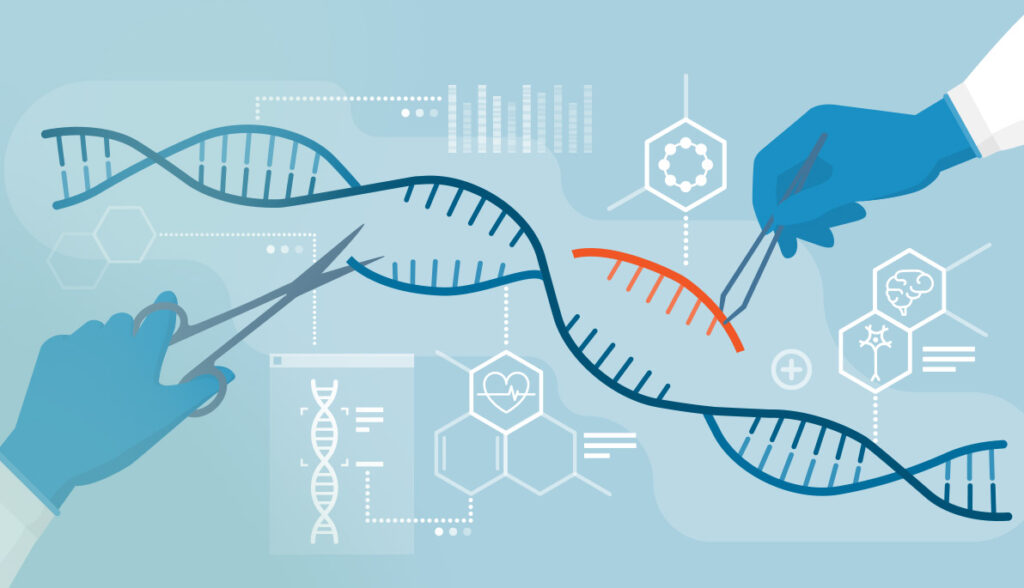
学習目標 (Objective)
CRISPRやその他の最新のゲノム編集技術について英語で自然に表現する力を身につけます。また、Wernickeを使ってスピーキングやライティングの自習ができ、英作文の添削や英語の自己採点機能で成長を確認できます。
Vocabulary Table
| Word / Phrase | Definition |
|---|---|
| genome | the complete set of genetic material in an organism |
| mutation | a change in a gene or chromosome |
| precision | the quality of being exact and accurate |
| therapy | a treatment to help a person recover from an illness |
| ethical | relating to moral principles about what is right and wrong |
Reading
In 2025, genome editing is taking leaps from research labs into real‑world treatments. One major milestone was the trial of a prime editing system in a teenager with a genetic immune disorder. Unlike traditional CRISPR-Cas9, prime editing can make changes without cutting DNA’s double strands, offering higher precision in fixing mutations. This “ultra‑powerful” tool restored immune function and marks a major step toward safer, more effective gene therapies. (News, Dreamstime, Nature)
Another breakthrough emerged from the Children’s Hospital of Philadelphia, where researchers completed a clinical trial using a personalized CRISPR base-editing therapy to correct a rare metabolic condition in an infant named KJ. This rapid, customized treatment enabled his health to improve remarkably—a powerful promise for treating other rare diseases. (AP News)
Beyond human therapies, the technology is branching out. For example, scientists have identified hidden microproteins that regulate fat cell growth using CRISPR. This finding could revolutionize obesity therapy by going beyond current drugs. (ScienceDaily) Meanwhile, agriculture benefits too—Mars Inc. is exploring gene editing to create hardier cocoa plants and safeguard supply chains under environmental threat. (Bloomberg.com)
However, these innovations raise complex ethical questions. Only recently, researchers demonstrated in lab-grown cells that CRISPR might remove the extra chromosome responsible for Down syndrome. While technically remarkable, such approaches spark intense debate about genetic “enhancement” and societal impacts. (scmp.com)
Altogether, 2025 is proving that genome editing is more than a technological novelty — it is steadily becoming a versatile, powerful tool in medicine, agriculture, and beyond.
Vocabulary Practice
課題: 今週の語彙から2つ以上を使って、3–4文の短いパラグラフを書きましょう.
例文:
The personalized therapy for the infant was highly precise, correcting a mutation that would otherwise remain untreatable. This clinical trial shows how genome editing can offer new hope for rare diseases.
Speaking & Discussion Practice
指示:
Wernicke(英作文の添削・自動採点機能付き)を使い、以下の質問から2問を選んでアプリで声に出して答え、クラスで発表の準備をしてください。
- What are the advantages of precision editing techniques like prime editing over traditional CRISPR?
- How might personalized CRISPR therapies change the future of medicine for rare diseases?
- Should we use CRISPR to edit human embryos or remove the extra chromosome in Down syndrome? Why or why not?
- Can gene editing in agriculture, such as creating hardier crops, be justified ethically?
- What role do clinical trials play in ensuring therapy safety and effectiveness?
Creative Writing Task
課題: 150–200語で、CRISPR and genome editingに関連したショートストーリーを書いてください。必ず3つ以上の語彙を使いましょう。
例頭出し:
“In the sterile glow of the lab, the guide RNA hovered over the cell’s genome like a beacon, directing the enzyme to its exact target. With precision, the team corrected a single mutation, offering hope in a world searching for cures…”